Legacy CICS/IMS systems power critical banking transactions, but integrating them with Python microservices poses challenges in data formats, transaction protocols, and integrity. This white paper presents a comprehensive framework for bridging this divide.
The Integration Challenge
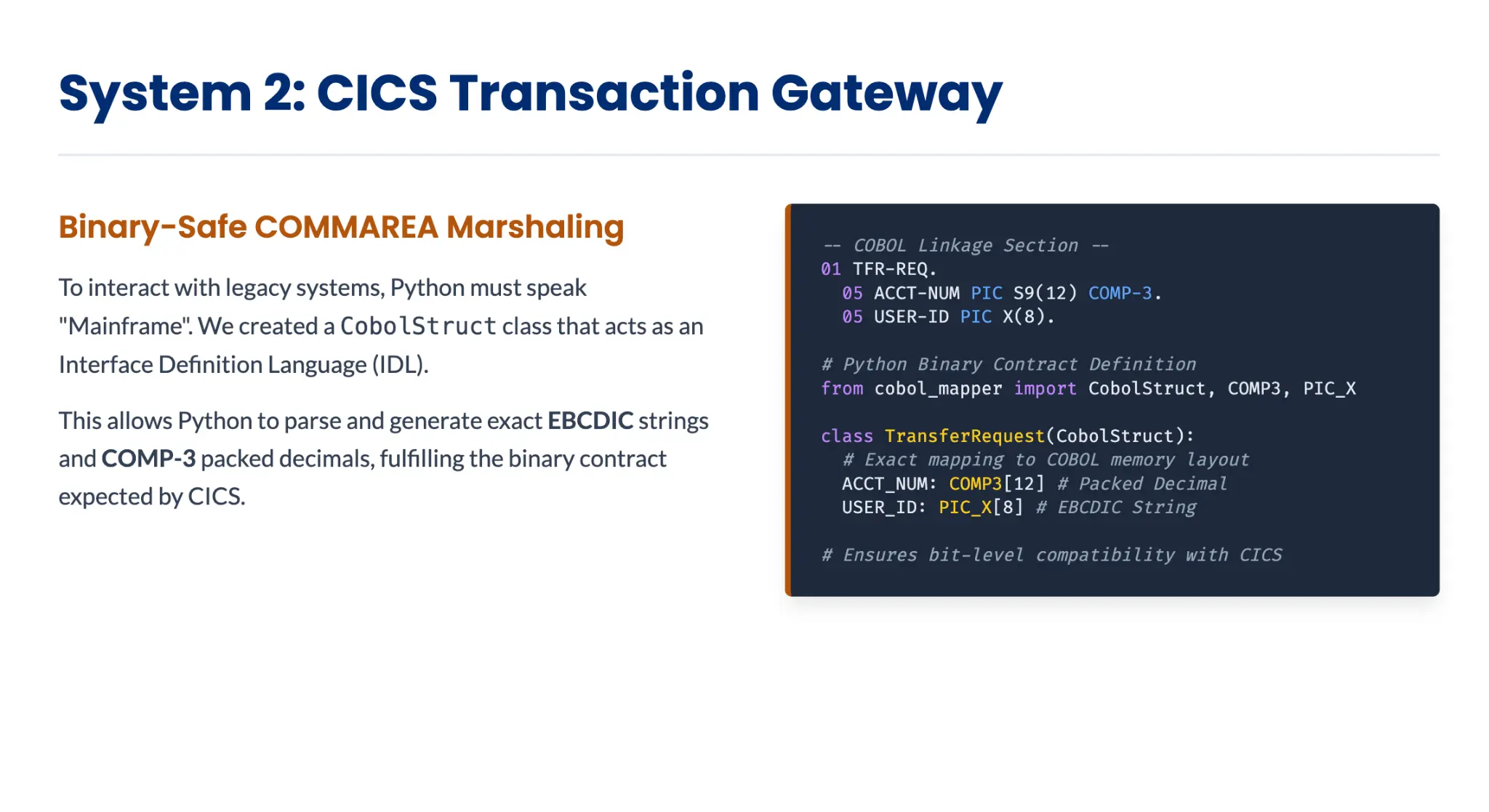
Mainframe systems operate on EBCDIC encoding and fixed-width binary formats (like COMP-3), while modern Python services expect ASCII and variable-length objects. Direct integration often leads to data corruption or precision loss ("penny drift").
Our solution addresses these challenges by providing a mock CICS service, a robust COBOL data mapper, and a transaction gateway that speaks both languages fluently.
Architecture
Core Components
- COBOLDataMapper: The Rosetta Stone of the system. It parses COBOL copybooks and handles the complex translation between EBCDIC/ASCII and unpacking COMP-3 decimals.
- MockCICSService: Simulates the CICS runtime environment, including channels, containers,
EXEC CICS LINK PROGRAMcalls, and syncpoint management. - MockCICSClient: A high-level API abstraction for common banking operations like Balance Inquiry (BANKINQ) and Funds Transfer (BANKTFR).
Data Structures
The system implements standard banking copybooks:
- WKINQ-REQUEST/RESPONSE: Handles balance inquiries, preserving the precision of
PIC S9(13)V99 COMP-3fields. - WKTFR-REQUEST/RESPONSE: Manages transfers, ensuring source and target balances are updated atomically.
Key Features
- Precise Data Mapping: Handles
PIC X,PIC 9, andPIC S9(n)V99 COMP-3fields with bit-level accuracy. - Transaction Modes: Supports both Read-Only (no syncpoint) for inquiries and Write (auto-syncpoint) for transfers.
- Audit Trails: Generates full transaction logs for compliance and debugging.
- Error Handling: Maps native CICS return codes to meaningful application responses.
COBOL Emulation Details
Technical fidelity is paramount for risk-free migration:
- COMP-3 Precision: Implements exact byte-length calculations (
ceil((digits+1)/2)) and correct sign nibble handling (C for positive, D for negative). - Copybook Parsing: Uses regex to parse PIC clauses and hierarchical levels, dynamically generating Python data structures.
- Program Linkage: Simulates realistic delays and mock database updates to mirror production behavior.
Conclusion
This framework proves that you don't need to choose between the stability of the mainframe and the agility of Python. By preserving COBOL/CICS fidelity at the integration layer, banks can modernize their stack while maintaining the rigorous standards of their legacy core.